Venezuela's oil reopening has been announced many times this year. What changed in the second half of August is that it stopped being a policy story and became a procurement story. On August 18, at a Houston showcase held inside the IMAGE 2026 conference agenda, Oil Minister Paula Henao signed the first production contracts between Venezuela and American independents since the sanctions era began.
Two weeks later, on September 2, U.S. Energy Secretary Chris Wright stood in Miraflores Palace beside interim President Delcy Rodríguez while Chevron, Eni, GE Vernova and two smaller operators put their names to a second round of agreements. Between those two ceremonies, Reuters published a report that framed the entire problem: Venezuela is now selling crude faster than its ports can load it. Both things are true at once.
The commercial door is open wider than at any point since 2019, and the physical plant be‐hind that door cannot yet move what the contracts imply. For anyone supplying equipment, crews or field services into this market, that gap is the entire opportunity — and the entire risk
Three agreements came out of the August 18 session, and their legal shapes are not the same, a distinction that matters more than the headlines suggested.
Hunt Oil, the privately held Dallas producer, signed a hydrocarbons productive participation contract covering the Caro and Carisito fields in eastern Venezuela, mature acreage in PDVSA's Oriente division that produces light crude and associated gas. This is the first instrument of its kind granted to an American independent under the reformed framework. Chief ex‐ecutive Hunter L. Hunt framed the move as a constructive role in rebuilding Venezuelan output. Neither investment figures nor target volumes were disclosed.
SLB, formerly Schlumberger and the largest oilfield services company in the world, signed something narrower: a framework alliance covering integrated reservoir studies across the country. That is a services and subsurface-data agreement, not a production stake. Its operational significance lies elsewhere — in the rigs SLB already owns inside Venezuela, discussed below.
Crossover Energy, a small Colorado company formed in 2022, secured acreage in the east. Its chief executive, Eric McCrady, told reporters at the Houston event that 3.5 million barrels per day is achievable within five to ten years, drawing an analogy to the pace at which modern completion techniques transformed the Permian Basin. That figure sits far above every institutional forecast currently on record and should be read as an operator's ambition rather than a projection.
The setting was as significant as the paperwork. Henao delivered her pitch from a stage in Houston, sharing a panel with U.S. Deputy Secretary of Energy Kyle Haustveit, and told the room that January's reform of the Organic Hydrocarbons Law gives foreign investors the regulatory certainty they had been waiting for. That reform removed the long-standing requirement that PDVSA hold majority control of joint ventures — the single legal change that makes concession-style contracts possible at all.
Francisco Monaldi of Rice University's Baker Institute called the contracts a meaningful milestone, while cautioning that the open question is whether companies actually deploy resources on the ground.
On the same day, Bloomberg reported that BP had obtained a U.S. Treasury licence to lift and resell Venezuelan crude, joining Vitol and Trafigura in a small group of Washington-approved intermediaries. The first cargo was concrete: the tanker Monte Lema loaded roughly 400,000 barrels of heavy fuel oil supplied by PDVSA, bound for Houston.
The structure of these trades is unusual and worth understanding, because it determines who actually holds the cash. Buyers do not pay Caracas directly. Proceeds are deposited into an account controlled by the U.S. Treasury and released from there, a mechanism reported by Bloomberg and reflected in the reporting requirements attached to General Licence 46. Under GL 46, any party exporting or reselling Venezuelan-origin oil to destinations outside the United States must file detailed transaction reports — counterparties, volumes, values, destinations and any payments made to the Venezuelan government — within ten days of the first transaction and every ninety days thereafter.
The volume moving through this channel is already substantial. Vitol and Trafigura together have shipped more than 140 million barrels of crude and fuel this year, the majority of it to the United States. Energy Department officials put more than 500,000 barrels per day of Venezuelan crude currently flowing into U.S. refineries — much of it to Gulf Coast plants configured for exactly this kind of heavy, sour barrel, which domestic light-sweet shale cannot substitute for
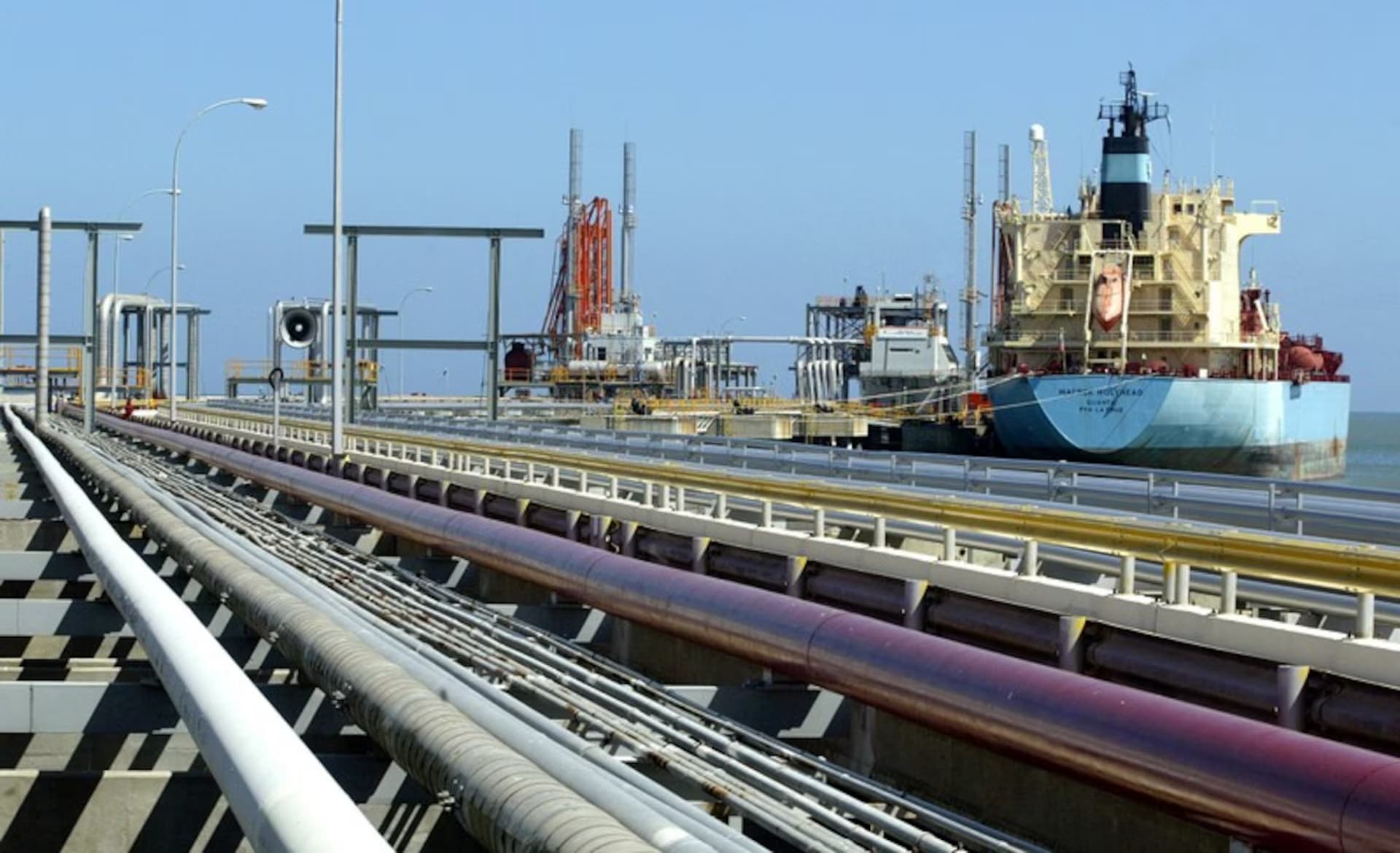
On August 21, Reuters reported from Puerto La Cruz that Venezuela's port terminals are imposing what amounts to an export cap. Tankers are waiting as long as thirty days to load. The Jose terminal, which handles roughly 70 percent of national exports, logged repeated interruptions through the year from equipment failures, power outages and crude-quality problems. At the neighbouring Guaraguao facility, only two of seven docks were fully operational in mid-August.
Some of the congestion is legacy debris in the literal sense. Docks remain occupied by sanctioned vessels that arrived during the isolation years and never left, including one rusting tanker that has sat at Guaraguao for two years. The commercial consequences are already flowing downstream: disputes over demurrage, quality and contamination, with PDVSA agreeing in some cases to settle penalties in crude. Even Chevron — which has decades of dock priority through its joint ventures — has been asking about access to terminals previously reserved for domestic shipping.
The result is a ceiling that has held near 1.25 million barrels per day despite rising production, inventory drawdowns and strong demand for heavy sour grades. And the pressure on that ceiling is about to increase, not ease: under the migrated contract terms, many PDVSA partners will market their own share of output independently, which multiplies the number of parties competing for the same limited docks space.
The rig picture is starker than the port picture. Baker Hughes counted roughly two active on‐ shore drilling rigs in Venezuela in July 2026 — in a country whose ministry planning contemplates something on the order of ninety active rigs by 2028 to hit its production targets. That is not a marginal shortfall. It is the whole problem, and it is a problem of equipment and people rather than reserves.
SLB's contribution here is more consequential than its framework agreement. William Antonio, the company's president for Mexico, Central America and Venezuela, told Reuters that SLB is preparing to reactivate as many as fifteen rigs already sitting inside the country, with all fifteen potentially working within a year and as many as four returning to service before the end of 2026, depending on contracts signed with producers. Smaller workover units go first — a detail that reflects where the early barrels actually come from. Thousands of wells are idle; pulling units and light workover iron recover production faster and cheaper than new pads in the Orinoco.
Reactivation is not free. Reuters reporting earlier in the year put refurbishment of stored rigs above one million dollars per unit in some cases, with operators generally requiring roughly twelve-month contracts to justify the spend. Private equity firm Formentera Partners is separately in discussions with international service companies about importing additional rigs. Halliburton has said it has been talking to customers about potential Venezuelan operations after conducting site assessments.
Two further constraints rarely make the headlines and both are construction problems, not
drilling problems. The first is upgrading capacity. Orinoco crude is extra-heavy — broadly in the 8 to 16 degree API range against roughly 39 to 40 for West Texas Intermediate — and the Jose-complex trains were built to convert that bitumen into a synthetic grade that can actually be sold. Several have been run into the ground. Rebuilding one is a multi-year industrial project, not a maintenance ticket.
The second is diluent. Extra-heavy crude will not move through a pipeline unaided; it has to be cut with a lighter hydrocarbon, in practice naphtha. Washington authorised U.S. diluent exports to Venezuela under General Licence 47 on February 3 precisely because this is a binding operational dependency, and volumes reported in trade coverage now run above 100,000 barrels per day southbound. Every incremental barrel of Orinoco production carries a diluent import obligation with it.
Power sits underneath all of it. Venezuela's electricity deficit is severe enough that interim President Rodríguez singled out the GE Vernova grid agreement for particular emphasis at the September 2 ceremony — and the same power outages that darken the grid are among the causes Reuters identified for loading interruptions at Jose. Generation is not a side issue for the oilfield. It is the oilfield.
Any operator reading the Houston contracts in isolation will misread this market, because the largest transaction of August involved no traditional producer at all. On August 31, the White House published the terms of an agreement under which Venezuelan interim authorities granted North American Blue Energy Partners — described in the fact sheet as the country's second-largest private producer, currently pumping around 250,000 barrels per day — 100-year concessions over 17 oil fields holding approximately 65 billion barrels of proven reserves. For scale: the entire United States holds roughly 46 billion barrels of proven reserves.
The governance terms are what make it without precedent. NABEP granted the U.S. Department of War's Office of Strategic Capital a 35 percent equity stake in its corporate parent at no cost to taxpayers. The State Department obtained the right to purchase 20 percent of current and future output at production cost, plus a right of first refusal on the remaining 80 percent. Washington holds a veto over board appointments, a majority of directors must be U.S. citizens, and the contract is governed by U.S. law and adjudicated in U.S. courts. Secretary of State Marco Rubio and Secretary of War Pete Hegseth signed on the American side.
The agreement is contested. Critics in both countries have questioned what it means for Venezuelan sovereignty, and the argument will run for months. But for a supplier or service company, the operative number is the one furthest from the politics: NABEP's commitment to invest up to $100 billion in Venezuelan oil infrastructure. Even partially executed, that is a procurement pipeline — compression, generation, drilling iron, camps, roads, pipe, terminals — and it lands in a country that today runs two onshore rigs.
The pattern is unmistakable: independents and service companies are signing now. The largest American majors, with the single exception of Chevron, are not.
Venezuela carries a very large body of pre-existing creditor claims, expropriation arbitration awards and sovereign bond defaults. Analysis by FTI Consulting cited in trade coverage puts the total in the region of $170 billion, much of it already enforceable in U.S. courts. New capital invested under contracts signed today is structurally subordinated to those claims. This is the clearest single reason the largest American majors other than Chevron have not moved, and it is the question any entering company's counsel will ask first.
Almost none of the August contracts came with investment figures, target volumes or term sheets. Bloomberg's own commodities newsletter described the process as opaque and the rules as uncertain. Suppliers pricing bids against these announcements are, in practice, pricing against press releases.
Every forecast now circulating — Crossover's 3.5 million barrels per day, the ministry's ninety rigs, NABEP's $100 billion — depends on refurbishing, importing, staffing and powering physical equipment inside a country that currently runs two onshore rigs and cannot reliably load the crude it already produces. Geology is not the constraint. Deployment is.
Strip away the ceremony and a barrel of Venezuelan crude has to clear six physical stages before it reaches a Gulf Coast refinery. August moved the legal position at both ends of that chain — licences at the front, offtake at the back. It moved almost nothing in the middle. For a U.S. company evaluating entry, the middle is where the schedule and the capital actually go.
Companies that have gone through this describe a consistent order of operations, and it is longer than a contract signing implies. Equipment has to be sourced in the United States and physically imported, because domestic supply for compression, generation and drilling components is thin. Customs clearance and permitting run at a Venezuelan cadence and cannot be compressed by paying more. Remote fields need camps, charters and ground transport before a single crew arrives. Local technicians need training on equipment that has been idle for years. Regulatory reporting has to meet U.S. standards, including the transaction-level disclosure that General Licence 46 requires of anyone reselling Venezuelan-origin oil outside the United States. And security coordination and government liaison, at both national and state level, are continuous functions rather than one-time approvals.
None of that is exotic. All of it takes time that most entering companies underestimate, typically by six to twelve months. In a window that participants broadly expect to be measured in a few years, that is not a rounding error. It is the difference between producing during this cycle and arriving for the next one.
In Planterra's experience, companies without an established local platform typically lose six to twelve months to equipment importation, customs, permitting, staffing, security coordination and regulatory setup before producing anything. With an operating partner already on the ground, that compresses to weeks, because the logistics network, supplier relationships and government liaison already exist.
Broadly, yes, under OFAC authorisation. General Licence 46, issued January 29, 2026, authorises established U.S. entities to lift, export, store, market, purchase, transport, sell and refine Venezuelan origin oil. General Licence 47, issued February 3, authorises U.S. diluent exports to Venezuela. Both carry conditions, and GL 46 imposes detailed reporting on any resale to destinations outside the United States. Sanctions have not been lifted wholesale; they have been licensed around. Any specific transaction needs its own legal review.
OPEC-based estimates put July 2026 crude production at roughly 1.117 million barrels per day. Venezuelan official figures cited through August run closer to 1.25 million. Exports have been unable to push meaningfully above roughly 1.25 million b/d in recent months, which Reuters attributes to port capacity rather than production. More than 500,000 b/d is currently reaching U.S. refineries.
January 2026's reform of the Organic Hydrocarbons Law removed the requirement that PDVSA hold majority control of joint ventures, which is what makes concession-style arrangements possible. Three shapes appeared in August: productive participation contracts covering specific fields (Hunt Oil), services and subsurface frameworks (SLB), and long-term concessions (NABEP). Dozens of existing joint venture contracts are separately being migrated to the new terms.
OPEC-based estimates put July 2026 crude production at roughly 1.117 million barrels per day. Venezuelan official figures cited through August run closer to 1.25 million. Exports have been unable to push meaningfully above roughly 1.25 million b/d in recent months, which Reuters attributes to port capacity rather than production. More than 500,000 b/d is currently reaching U.S. refineries.
In Planterra's experience, companies without an established local platform typically lose six to twelve months to equipment importation, customs, permitting, staffing, security coordination and regulatory setup before producing anything. With an operating partner already on the ground, that compresses to weeks, because the logistics network, supplier relationships, and government liaison already exist.

We operate in Venezuela under Big Oil standards—so you don’t build locally or manage ops on the ground.