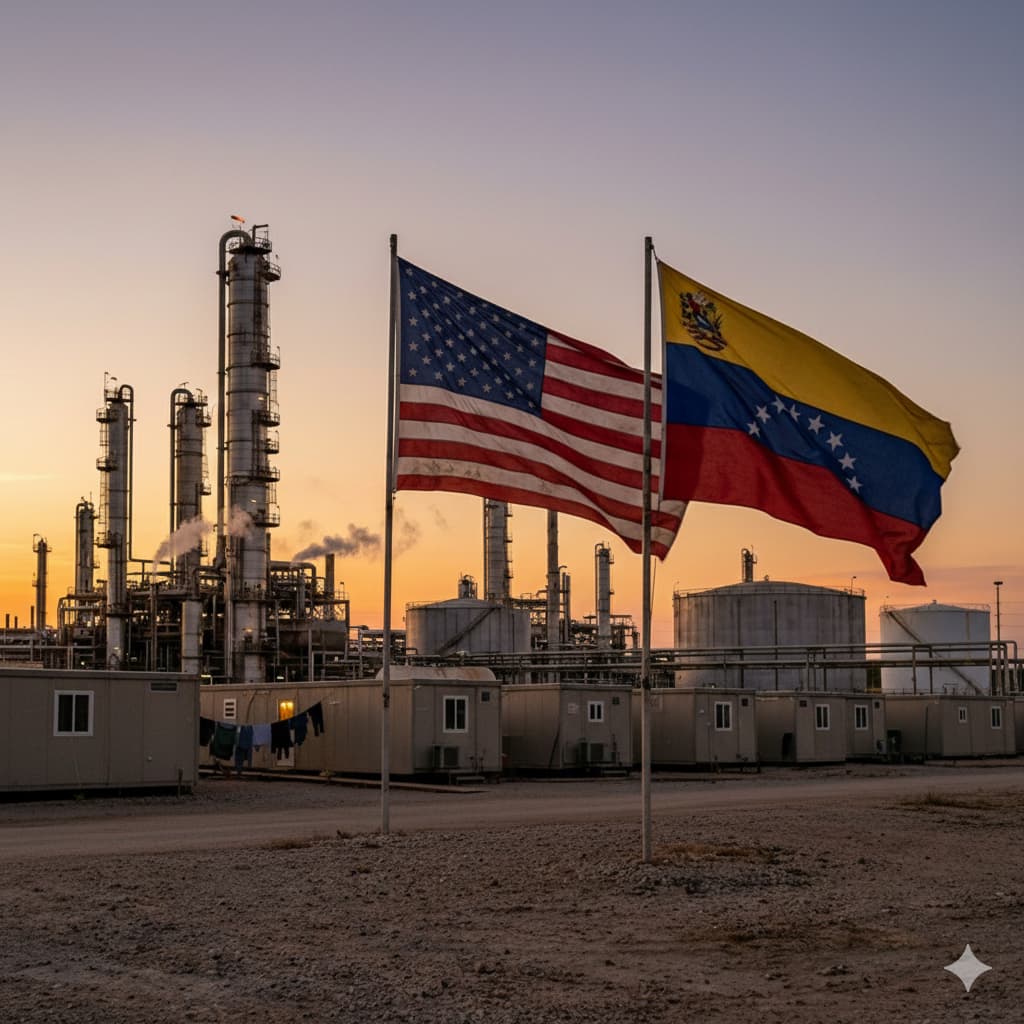
In a landmark announcement from Mar-a-Lago, President Donald Trump declared that US oil companies would lead the rebuilding of Venezuela's energy sector — one of the most significant energy policy statements in a generation.
"We're going to have our very large United States oil companies — the biggest anywhere in the world — go in, spend billions of dollars, fix the badly broken infrastructure — the oil infrastructure," Trump said. CNN
Venezuela holds 303 billion barrels of proven crude reserves — approximately one-fifth of the world's total supply, according to the US Energy Information Administration.
Despite this enormous resource base, the country's production capacity has declined dramatically over the past two decades.
Venezuela's production peaked at 3.5 million barrels per day in the late 1990s, but has since fallen sharply, with current output standing at around 800,000 barrels per day.
Trump's announcement signals a commitment to reversing that decline through American capital and technical expertise.
The move aligns with broader efforts to reopen Venezuela’s energy sector to international investment following major geopolitical developments earlier in 2026.
The Trump Administration moved quickly to back up the rhetoric with action — issuing several general licenses at record speed to enable oil and gas companies to make unprecedented investments in Venezuela's energy infrastructure.
These licenses authorize US firms to:
Recent policy shifts have already begun allowing major international oil companies to resume operations and negotiate new investments in the country.
Chevron Vice Chairman Mark Nelson told Trump the company has a path forward to increase its Venezuelan production by 50% within 18 to 24 months.
For companies with an established presence in Venezuela — and partners who can facilitate on-the-ground operations — this moment represents a generational opening.
However, rebuilding Venezuela’s oil infrastructure will require far more than capital investment. Companies entering the market will need to rapidly mobilize personnel, equipment, and operational bases in regions where infrastructure has been limited or deteriorated.
Companies evaluating projects often rely on partners that can provide boots-on-the-ground operational support in Venezuela, helping teams mobilize quickly without building permanent infrastructure from scratch.
Large-scale projects typically require:
Solutions such as modular workforce housing and site infrastructure allow energy companies to deploy teams quickly while maintaining flexibility during early exploration and development phases.
For companies prepared to operate in Venezuela’s evolving energy landscape, the coming years may represent one of the largest oil infrastructure rebuilds in decades.
With global energy companies evaluating new investments and US policy opening the door for international participation, the rebuilding of Venezuela’s oil industry could reshape the region’s energy economy.
Companies that establish reliable operational infrastructure early will be best positioned to participate in the next phase of Venezuela’s energy sector development.
Planterra Construction provides boots-on-the-ground infrastructure and modular workforce housing designed to help energy companies mobilize quickly and operate efficiently.
Contact us today to discuss how we can support your expansion into Venezuela.

We operate in Venezuela under Big Oil standards—so you don’t build locally or manage ops on the ground.